Oretta: a time tracker tailored to my needs
A timer, a task board and reports in one small app, without unnecessary features. It went from idea to production in less than two weeks, and I use it every day.
- Client
- Personal product
- Year
- 2026
- Role
- Product, design and engineering, end to end
Context
As a freelancer I track every hour I work for each client. I used Toggl, a solid tool built for teams, but most of what it offered I never touched.
Problem
I wanted something simpler and shaped around my own work: time logged against customers, projects and tasks, a board to plan the tasks, and clear totals for any week or month. No off-the-shelf tool did exactly that without extra features and a subscription.
What I built
Oretta (Italian for “a little hour”) is a small web app that does one job well: tracking where my working time goes.
- A timer on every page. Start it on a task with one tap, and starting a new one stops the previous one.
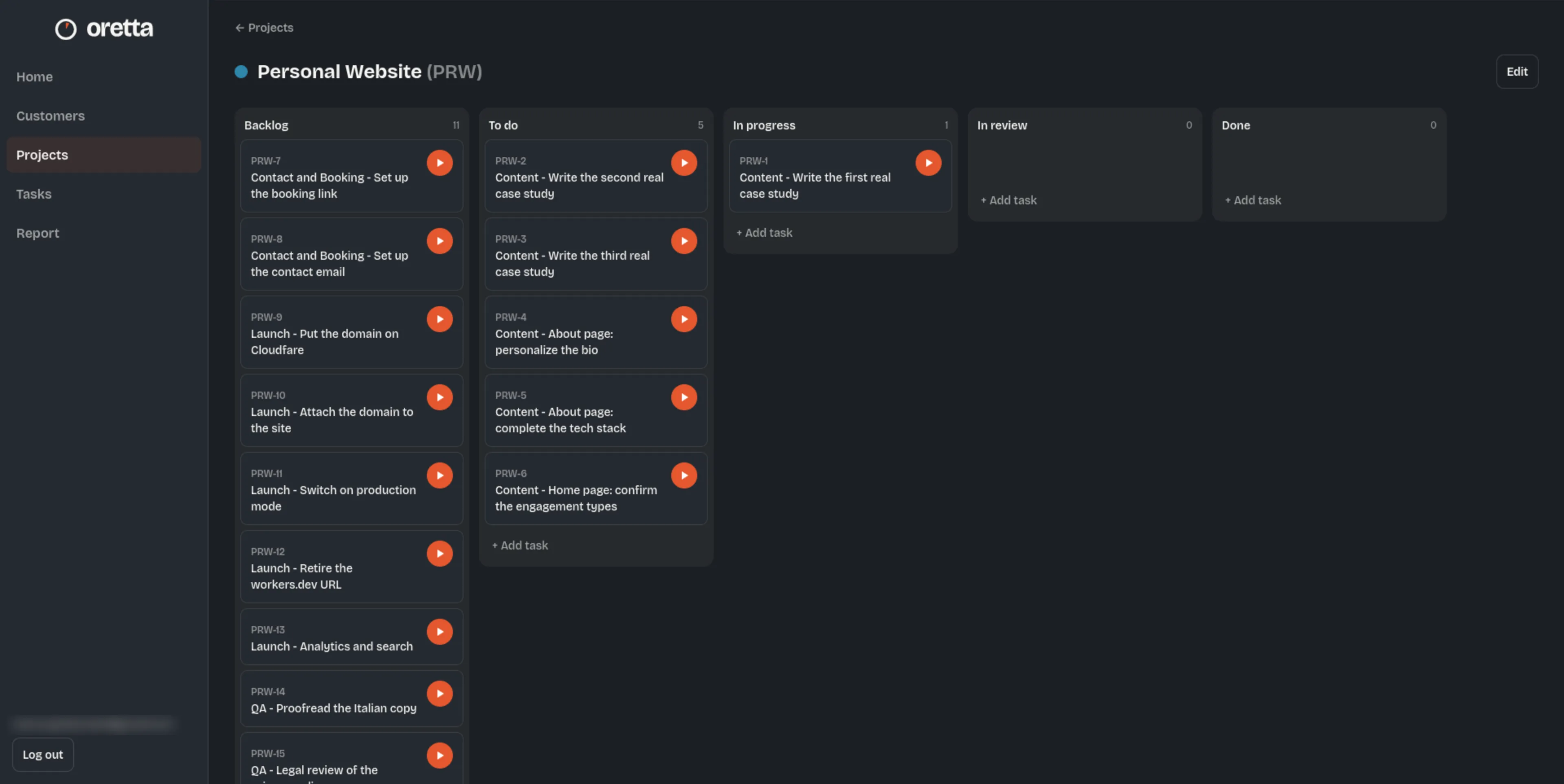
- A board for each project. Tasks move through the usual steps, from backlog to done, by drag and drop. Each one shows the time tracked against its estimate.
- A week view. A calendar of the week, or a list, to check and fix entries.
- Reports. Totals for any period, grouped by customer, project and task, ready for invoicing.
- An installable app. It works on phone and desktop, in light and dark mode.
How I built it
I started from a short brief describing the product, then worked it out with an AI coding assistant (Claude) into a full plan: the data model, the conventions and thirteen small phases, each one shipping something usable. Then we built it phase by phase. I made the product and architecture decisions and reviewed every change, and the assistant sped up the coding. Every phase had to pass type checks, linting and automated tests before it counted as done.
The result is a fast way to work that stays disciplined: a production app in less than two weeks, without cutting corners on quality, security or deployment.
- Secure by default. Sign-in is protected against repeated guessing, and every query only ever sees its owner’s data.
- Safe releases. Pushing a change deploys it. Database migrations run before the new version goes live, and they’re kept backwards compatible, so the running app keeps working during a release.
Tech used
- TypeScript
- Node.js
- React
- Hono
- PostgreSQL
- Drizzle
- Vercel
Result
Replaced Toggl in my daily work, from idea to production in less than two weeks
I use it every day, on my phone and on my laptop. My whole Toggl history was imported, so nothing was lost in the switch. New features go live by pushing a change, and database updates are applied safely as part of each release.